No Prompts, No Photoshop: Just Talk to AI and Watch These Ancient Beasts Come Alive
In a world filled with prompt-based generators and complex AI image generation tools, a surprising new creative process has emerged — one where all you need is conversation. Using ChatGPT-4o’s image generation capability, I set out to bring to life the mythological creatures from The Classic of Mountains and Seas — one of the most mysterious and imaginative texts in ancient Chinese mythology.
What started out as a casual experiment quickly turned into a deep dive into visual storytelling with AI — no Photoshop, no prompt engineering, and no technical knowledge required.
It All Began with Xing Tian: A Warrior Without a Head
Like many fans of Chinese mythological creatures, I’ve always been fascinated by the beings from The Classic of Mountains and Seas — a 2,000+ year-old compilation of bizarre, beautiful, and otherworldly entities. One of the most famous is Xing Tian (刑天) — a decapitated warrior who continues to fight with a face on his chest and weapons in both hands.
I’d tried to generate an image of Xing Tian using previous AI tools — with limited success. The results were close, but never quite captured the eerie beauty of the myth: sometimes a face on a torso, sometimes a headless body, but rarely both. And certainly not with the visual finesse I had in mind.
Choosing the Right Creatures to Generate with AI
After the successful rendering of Xing Tian, I decided to expand the experiment and explore more mythical beings from The Classic of Mountains and Seas. I looked for those with vivid, unusual appearances — the kinds of creatures that challenge both human imagination and AI interpretation.
Here’s a list of the beings I generated, along with brief descriptions based on traditional sources. I’ll be showcasing the images I created under each entry.
🐟 Kun Peng (鯤鵬)
A massive fish that transforms into a giant bird. Kun represents the oceanic fish, while Peng symbolizes the soaring bird — a metaphor for boundless transformation and ambition.
⚔️ Xing Tian (刑天)
🐂 Kui Niu (夔牛)
A one-legged beast that resembles a cow or ox, often associated with thunder and music. Its body emits a sound like a thunderclap, and its presence brings awe.
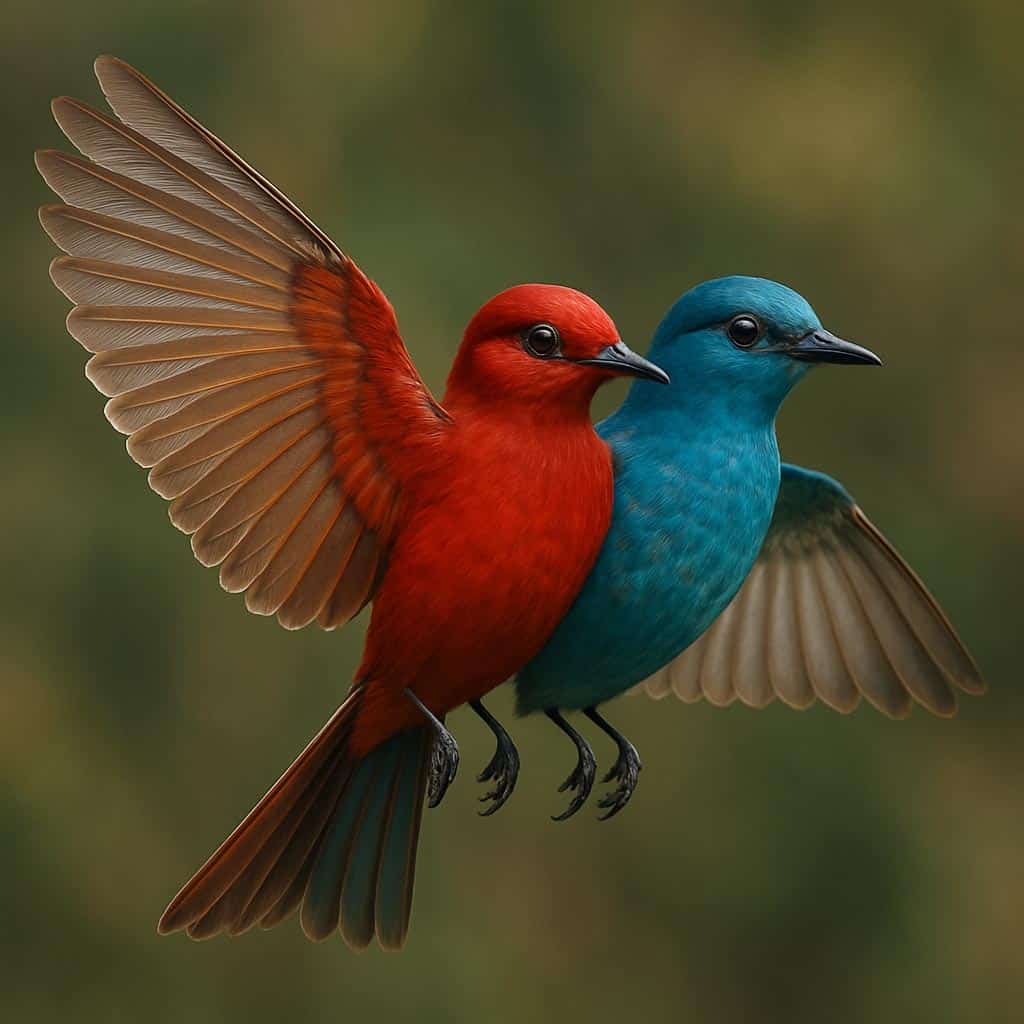
🐦 Bi Yi Niao (比翼鳥)
A mythical bird that is said to have only one wing — always appearing in pairs. Together, they can fly, symbolizing deep love, loyalty, and perfect union.
🌫️ Hun Tun (混沌)
A formless, featureless creature that represents primordial chaos. Often depicted without eyes, nose, or mouth — symbolizing the void before creation.
🐏 Xie Zhi (獬豸)
A righteous and intelligent beast, often depicted like a unicorn or a goat. It is known for its ability to distinguish right from wrong, and it punishes the guilty by ramming them.
🐍 Fei Yi (肥遺)
A serpent-like creature with four wings. Its appearance is considered an omen of droughts.
🦅 Ying Zhao (英招)
🔥 Fei (蜚)
A hornless, blue-grey beast with the body of an ox, one eye, and a snake’s tail. Its cry sounds like a wailing infant, and its appearance is said to foretell plague.
🐉 Chi Wen (螭吻)
A dragon-like creature often found on the rooftops of traditional Chinese architecture. It resembles a fish-tailed dragon and is believed to protect buildings from fire and evil spirits.
Each of these mythological creatures was brought to life using nothing more than natural language conversations with AI.
The Magic of AI Image Generation Without Prompts
What sets ChatGPT-4o (or other similar tools such as Grok) apart from traditional AI art generators like MidJourney or Stable Diffusion is that you don’t need to write complex prompts. You don’t even need to know what a “prompt” is.
Instead, I simply asked ChatGPT to describe a creature from the Classic of Mountains and Seas, verify its features, and then generate a visual. If the result wasn’t quite right, I just continued the conversation — no restarting, no tweaking a block of code-like prompt text. It’s AI-powered visual creation through dialogue, and it felt intuitive, fast, and creative.
In short: no prompts, no Photoshop — just talk.
From Photorealism to Pop Culture
I asked ChatGPT-4o to render the creatures as if they existed in the real world — photorealistic AI images of these beasts as if captured by camera. The results were stunning. Each creature looked like it had walked out of a lost world — strange, believable, and hauntingly beautiful.
As an experiment in contrast, I also asked for Simpsons-style versions of the same creatures. These cartoon-style renderings were bright, expressive, and surprisingly charming — the kind of visuals perfect for T-shirts, merch, or collectibles. The range from hyperreal to pop-art was seamless.
Why This Matters for Creativity, Design, and Education
While this began as a personal project, it has clear implications for creative industries. This isn’t just about generating images. It’s about changing how we create.
Here’s why this matters:
- Designers can use conversational AI to iterate ideas quickly, without being limited by technical tools.
- Educators can bring mythologies like The Classic of Mountains and Seas to life in classrooms with powerful visuals.
- Cultural storytellers and artists can use this method to reinterpret tradition through a modern lens.
This is the future of creative collaboration with AI — not driven by commands, but by conversation.
Final Thoughts
This experiment proved something simple but powerful: when AI understands both your words and your vision, creativity becomes frictionless.
From myth to image, from ancient text to modern visual — all it took was a little curiosity, and a conversation.
Please share this article if you like it!

No Comment! Be the first one.